
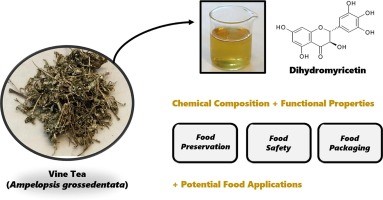
Herbal teas like vine tea (Ampelopsis grossedentata) have been traditionally consumed worldwide because of their health-promotion and pleasant taste. Vine tea and its main bioactive component, dihydromyricetin, have gained attention because of their potential applications in food, material, and pharmaceutical sciences. Vine tea and dihydromyricetin have been suggested as potential natural antioxidants to extend shelf life of foods. Studies have also suggested potential application in packaging and food safety. Additionally, dietary supplementation with vine tea extract have shown great potential to prevent metabolic diseases, which can justify its application in novel functional foods.
1. Introduction
Vine tea (Ampelopsis grossedentata Hand.-Mazz.), also known as “Teng Cha”, “Tocha”, “Rattan tea”, “Duan Wu Cha”, “Mao Yan Mei” or “Moyeam”, is a healthy herbal tea, rich in the natural antioxidant dihydromyricetin (DHM) or ampelopsin, and whose dried leaves and stems have been a significant plant resource in medicinal food research. DHM extracted from vine tea has been shown to have significant anti-inflammatory properties in vitro and in vivo, and it has been recommended as a potential therapeutic agent for inflammatory-related diseases.
2. Chemical components in vine tea
2.1. Polyphenols
Although rich in nutrients, vine tea is well known for its medicinal aspects, which are related to the secondary metabolites such as polyphenols. In recent studies, the total phenolic content (TPC) of vine tea extracts was estimated by following the Folin–Ciocalteu method (Baek et al., 2015, Xie et al., 2019, Ye et al., 2015, Ying et al., 2011) or a modified ferrous tartrate colorimetry method (Jia et al., 2021). TPC of a freeze-dried vine tea extract (VTE) obtained through ethanol extraction process (vine tea: commercial dried leaves and stems of A. grossedentata; solvent: 74% (v/v) aqueous ethanol; extraction conditions: 65 °C for 30 min; ethanol was evaporated (60 °C) from extract, then residue was frozen and freeze dried (−50 °C for 3 days); yield: 3.49 g extract (yellow powder)/10 g dried vine tea) was reported as 649 mg GAE/g (milligram of gallic acid equivalents (GAE) per gram) (Ye et al., 2015). Baek et al. (2015), who followed similar extraction method, reported their vine tea extract had a much lower TPC (310 mg GAE/g) and the TPC of green tea (Camellia sinensis) and grape seed extracts were 180 mg GAE/g and 380 mg GAE/g, respectively. Jia et al. (2021) recently reported TPC of extracts from young vine tea leaves as 444 mg GAE/g for green leaves and 446 mg GAE/g for red leaves; the researchers used 70% ethanol as solvent and an ultrasonic extraction procedure (30 min, room temperature), which was followed by filtration, evaporation of the solvent, and lyophilization. As a matter of comparison, TPC content of ethanol extracts from other tea or herbal tea ingredients were reported as following: green tea 144.52 ± 5.36 mg GAE/g tea, mate tea (Ilex paraguariensis) 66.86 ± 0.66 mg GAE/g tea, persimmon leaf tea (Diospyros kaki) 46.42 ± 0.95 mg GAE/g tea, and rosemary tea (Rosmarinus officinalis) 39.44 ± 0.92 mg GAE/g tea (Oh, Jo, Reum Cho, Kim, & Han, 2013). Despite of the wide TPC range reported in the literature, it is clear that vine tea polyphenol composition is extraordinarily high in comparison to other “healthy” tea ingredients.
Among the polyphenolic compounds, several flavonoids can be found in vine tea. The total flavonoid content of four A. grossedentata plant parts were recently reported as following: tender tip leaves 791.51 ± 20.79 mg/g, young green leaves 776.56 ± 23.95 mg/g, old green leaves 645.53 ± 16.21 mg/g, and unripened fruits 582.60 ± 23.43 mg/g . Also, green young leaves contained significant more flavonoids than old green leaves and both young and old red leaves .
In addition to the group of flavonoids, four isoflavones were isolated from methanol extract of vine tea (whole plants of A. grossedentata): 6,7-dihydroxy-3′-methoxy-4′,5′-methylenedioxy-isoflavone; 6,7-dihydroxy-3′-methoxy-4′,5′-methylenedioxyisoflavone 6-O-β-D-glucopyranoside; 6,7-dihydroxy-3′-methoxy-4′,5′-methylenedioxyisoflavone 6-O-α-L-rhamnopyranoside; and 6,7-dihydroxy-3′-methoxy-4′,5′-methylenedioxyisoflavone 6-O-β-D-xylopyranosyl-(1–6)-β-D-glucopyranoside.
Two flavonoid glycosides were obtained from aqueous extract of vine tea leaves (200 g of leaves were extracted two times with 1.5 L of hot water (60 ˚C) then concentrated to 500 mL. Concentrated solution was extracted with chloroform then lyophilized) and the use of high-speed counter-current chromatograph (HSCCC) performed with a two-phase solvent system (n-hexane–ethyl acetate–methanol–water, 1:6:1.5:7.5, v/v): 5,7-dihydroxy-3′,4′-trihydroxyflavone-3-O-6″-rhamnose, and 5,7-dihydroxy-3′,4′-dihydroxyflavone-3-O-6″-rhamnose.
Furthermore, vine tea can be naturally fermented in a similar manner to Camellia sinensis, and during the fermentation process, the rolling and crushing of the leaves and stems allows the oxidative enzymes polyphenol oxidase and peroxidase to react with the phenolic compounds, which may change the flavonoid composition. For instance, besides DHM and myricetin, three other flavonoids were identified in naturally fermented vine tea: 3-dihydroxyquercetin, iso-dihydromyricetin, and myricetin-3-rahmnose.
2.2. Dihydromyricetin (DHM)
DHM is the main bioactive component in vine tea and multiple review publications have already discussed the potential health benefits of this flavonoid, such as antioxidant, anti-cancer (e.g., inhibition of apoptosis, regulation of proliferation, metastatic inhibition), anti-inflammatory, anti-hypertension, hepatoprotective, and neuroprotective activities, as well as its promising use to prevent or treat metabolic diseases, such as NAFLD, diabetes mellitus, atherosclerosis, and osteoporosis. In a recent study in vitro, reported that DHM can alter the composition of the gut microbiota, but the flavonoid could be metabolized by it. Additionally, DHM was reported to improve physical performance under simulated high altitude, so its use may possibly avoid exercise intolerance and altitude-related illnesses caused by hypobaric .
2.3. Fatty acids
Fatty acids constitute another group of important chemical components present in vine tea; they add nutritional value and contribute to aroma formation. Thirty-one free fatty acids (FFA) were investigated in vine tea and the major fatty acids detected were 16:0 (palmitic, hexadecanoic acid), 18:0 (stearic, octadecanoic acid), 18:2ω6 (linoleic acid), 18:3ω3, ω6 (α-linolenic acid), and 20:4ω6 (arachidonic acid). Arachidonic acid was reported at an average of 4.3–4.4%, and was possibly misidentified. Arachidonic has not been identified in higher plants as the biosynthetic pathways do not exist. Linoleic acid was reported as the primary unsaturated fatty acid (PUFA), and octadecanoic acid was identified as the primary saturated fatty acid (SFA) in vine tea . Fatty acid content can be affected by vine tea harvest time (April, July or September) , which suggests vine tea aroma may be similarly affected by harvest.